
Deacons
The word means "servant." Deacons are ordained not to the priesthood, but to service, and their role at Mass reflects that identity.
You've seen them at the altar, vested in a dalmatic, proclaiming the Gospel, assisting the priest. But who are deacons, exactly? They're not priests. They're not laypeople. They occupy a unique place in the Church's ordained ministry, and understanding that place helps us see the Mass more clearly.
The word deacon comes from the Greek diakonos, meaning servant. That's not just etymology. It's identity. Deacons are ordained to service. While priests are ordained to act in persona Christi, in the person of Christ the Head, deacons are ordained to serve as Christ the Servant.
This distinction shapes everything they do.
At the Altar
At Mass, the deacon serves alongside the priest, but his role is distinct. He prepares the altar. He brings the gifts of bread and wine. He assists with the chalice. He purifies the sacred vessels after Communion. These actions aren't just logistical. They're liturgical. The deacon's presence at the altar is a sign that service is woven into the very structure of the Eucharist.
But the deacon's most visible moment comes earlier: the proclamation of the Gospel.
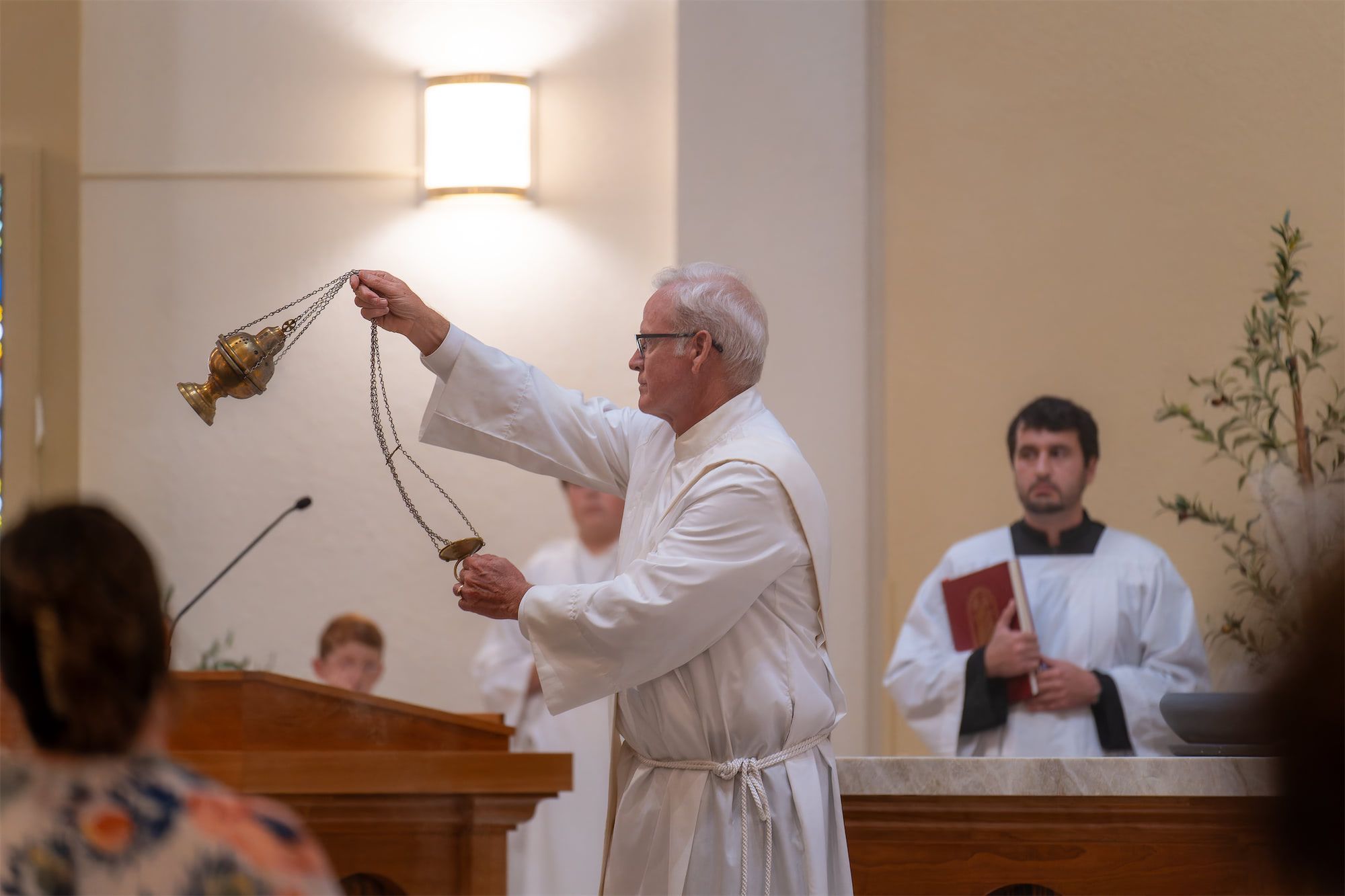
Only an ordained minister (deacon, priest, or bishop) can proclaim the Gospel at Mass. This is reserved. When the deacon carries the Book of the Gospels in procession, when he asks the priest's blessing, when he incenses the text and chants the words of Christ, something is happening. The Word is being made present with particular solemnity. The deacon's voice becomes the vehicle for the Gospel.
He may also preach. At the direction of the priest, the deacon can deliver the homily, breaking open the Scriptures for the faithful. And he leads the Prayer of the Faithful, gathering the needs of the community and lifting them to God.
The Dismissal
Here's something most people don't realize: the word Mass comes from the dismissal.
At the end of the liturgy, the deacon sends the assembly forth. "Go forth, the Mass is ended." Or: "Go and announce the Gospel of the Lord." The Latin is Ite, missa est, from which we get the word Mass. The dismissal isn't an afterthought. It's the hinge between liturgy and life. And it belongs to the deacon.
This makes sense. The deacon, ordained to service, sends the faithful out to serve. The Mass doesn't end at the church doors. It continues in the world. The deacon's final word reminds us of that.
Two Kinds of Deacons
In the early Church, the diaconate was a permanent ministry. The Book of Acts records the appointment of seven men to serve the community's practical needs, freeing the apostles for prayer and preaching. Stephen, the first martyr, was a deacon.
Over the centuries, the permanent diaconate faded in the Western Church. Men were ordained deacons only as a step on the way to priesthood, transitional deacons, as they're called.
The Second Vatican Council restored the permanent diaconate. Today, the Church ordains married men to serve as deacons for life. They hold jobs, raise families, and serve the Church in a way that bridges the altar and the world. Our own parish is blessed to have permanent deacons who serve faithfully in this way.
Transitional deacons still exist, seminarians ordained to the diaconate before their ordination to the priesthood. But the permanent diaconate has become a vital part of the Church's ministry, especially in parishes where priests are few.
Beyond the Mass
Deacons do more than serve at the altar. They baptize. They witness marriages. They preside at funerals and burials. They bring Communion to the sick. They preach and teach. In many parishes, they're deeply involved in charitable outreach, formation programs, and pastoral care.
What they cannot do is celebrate Mass or hear confessions. These belong to the priesthood. But within their proper sphere, deacons exercise real sacramental ministry. Their ordination is not a diminished priesthood. It's a distinct vocation with its own integrity.
A Sign of Service
The next time you see a deacon at Mass, watch what he does. He serves. He proclaims. He assists. He sends forth. His ministry is a visible reminder that Christ came not to be served, but to serve.
And in a Church that exists to continue Christ's mission, that reminder matters.