
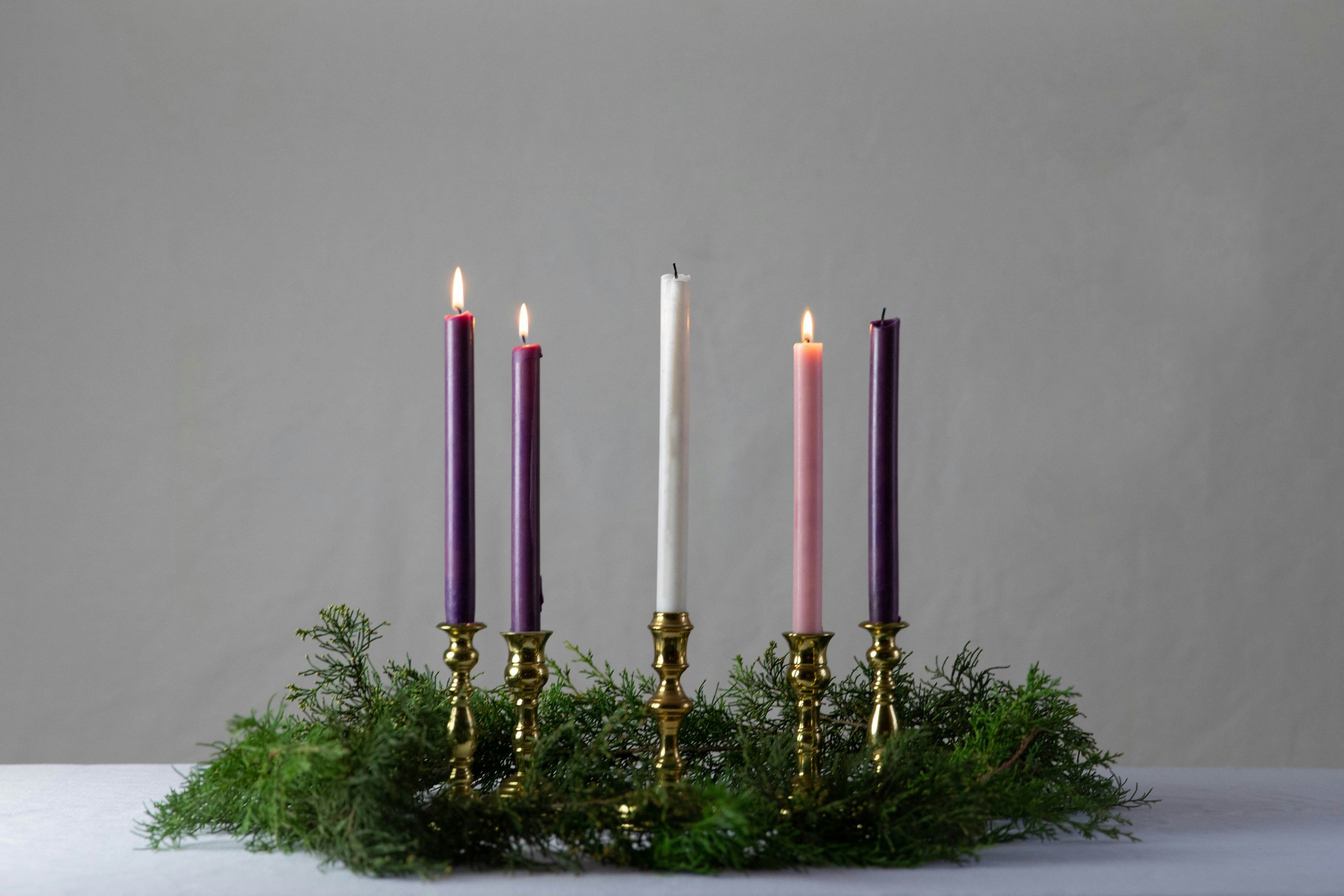
The Advent Wreath
A circle of evergreen, four candles, and light growing in the darkness. The Advent wreath is simple, but it carries centuries of meaning.
When Advent begins, the wreath appears.
In church, it takes its place near the altar. In homes, families set it on the table or the mantle. Four candles, three purple, one rose, rise from a circle of evergreen. And each Sunday, as the days grow shorter and the darkness deeper, another candle is lit.
It's a simple thing. But simple things often carry the most weight.
Light in the Darkness
The prophet Isaiah wrote of a people walking in darkness who have seen a great light. That image runs through all of Advent. We are waiting for light. And the wreath gives us a way to see that waiting unfold.
The first Sunday, one flame. The second, two. By the fourth Sunday, the wreath is bright, and Christmas is almost here. The growing light mirrors the growing hope. Something is coming. Someone is coming.
In a world of instant illumination (switches flipped, screens glowing), we can forget how powerful candlelight once was. But when you sit with an Advent wreath in a dark room, something old stirs. Fire has always meant presence, warmth, life. And in Advent, it means promise.
The Circle and the Green
The wreath itself speaks before any candle is lit.
Its shape is a circle, no beginning, no end. It reflects the eternity of God, the unbroken arc of his love. Like a wedding ring, it signifies a covenant that does not expire.
The evergreen branches hold their color through winter. While other trees go bare, the evergreen remains. It's a sign of life that persists, hope that endures even when the world seems dormant.
Circle and green. Eternity and life. The wreath tells us what kind of God we're waiting for.
Three Purple, One Rose
The candles mark the Sundays. Three are purple, the color of Advent, of penance and preparation. One is rose, for the Third Sunday, called Gaudete Sunday. Gaudete means "rejoice." Halfway through Advent, the Church lightens the mood. Christmas is near. The waiting is almost over.
Some traditions assign specific meanings to each candle: hope, peace, joy, love. These aren't official, but they're not wrong either. What matters is the movement: darkness giving way to light, one Sunday at a time.
A Tradition for the Home
The Advent wreath belongs in church, but it also belongs on your kitchen table.
The custom as we know it emerged in 19th-century Germany, where a Lutheran minister named Johann Hinrich Wichern used a wreath with many candles to help children count the days until Christmas. Catholics recognized the beauty of the practice and adopted it, simplifying it to four candles for the four Sundays.
At home, the wreath becomes a focal point for family prayer. Light the candles at dinner. Say a simple prayer. Let the children take turns. It doesn't need to be elaborate. The light does the teaching.
When the room is dim and the candles are burning, even small children sense that something is different about these weeks. The wreath makes Advent visible. It shapes the season without a word.
More Than Decoration
An Advent wreath is not a centerpiece. It's a prayer.
Each time we light it, we join generations of Christians who have waited in the dark for the coming of Christ. We join the prophets who spoke of a light dawning. We join Mary and Joseph on the road to Bethlehem. We join the whole Church, around the world, watching and waiting.
The light grows. The darkness thins. And soon, not yet, but soon, the waiting will give way to joy.
Keep your wreath lit through these weeks. Let it do its quiet work. And when Christmas finally comes, you'll know: the light we waited for has arrived.